
Worked case: a 55-inch TV on 1920s plaster in a hillside bungalow beside a built-in bookcase — how it is done and what it runs
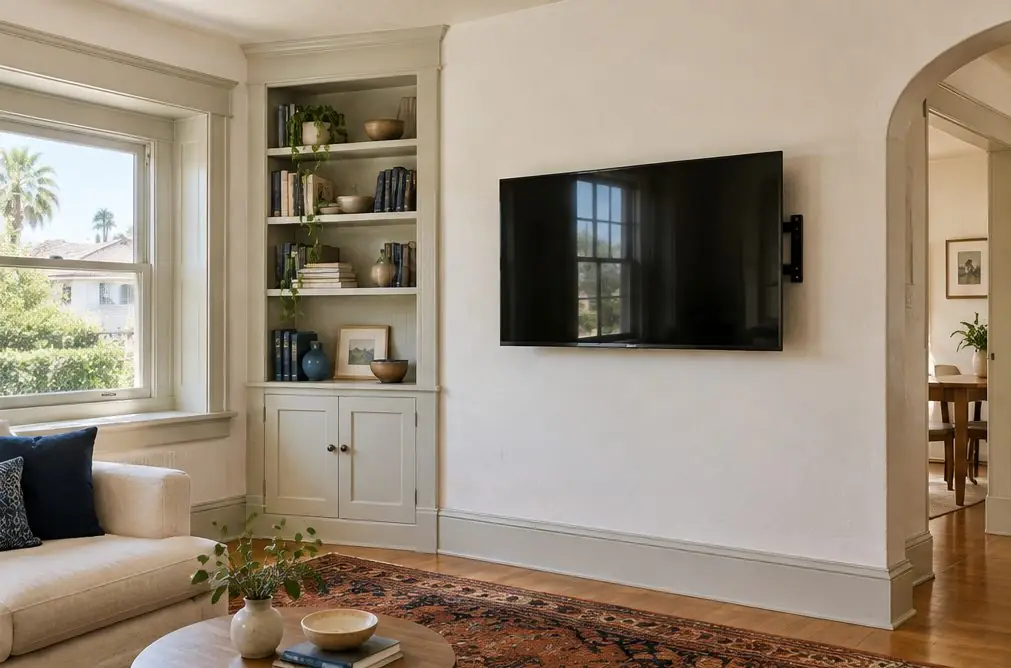
TV Mounting Line Fullerton describes a typical job in a hillside bungalow from the 1920s whose living-room walls are still plaster over wood lath: a 55-inch set on a fixed mount, studs proved by thin probe holes before any bolt goes in, a plate set clear of the built-in bookcase, and a painted channel carrying the cords to the outlet.
Bookings aren't open yet. Leave your name and number; your message is recorded, and you'll get one message when a local installer is available.
Worked example. The pictures are AI concept illustrations, not photographs; no installation was performed or arranged through this site; prices are typical Fullerton area market ranges, not quotes.
 Illustration
Project Examples & Typical Prices
The scenario
Picture a one-and-a-half-story bungalow on a sloping street north of downtown, built in the 1920s. The living room has a step down from the entry, a brick fireplace on one side, a built-in bookcase on the other and a deep window return whose casing was painted a dozen times. The walls are plaster over wood lath, with one stretch near the kitchen door that was patched in newer board when a doorway was moved.
The household wants a 55-inch screen that can be watched from the sofa and from the reading chair by the window. Nothing about the room invites a casual hole: the plaster is thick, the trim is original, and a stud finder held against it gives readings that change every few inches because the lath behind the plaster is a field of metal nails and uneven wood.
The only receptacle on the wall sits in the baseboard low and off to one side. The goal is a clean, level screen on the plaster wall between the fireplace and the bookcase, with the original woodwork and finish disturbed as little as possible.
What the job involves
- A strip of painter's tape marks the screen's footprint on the plaster wall, and the installer sits on the sofa and then in the reading chair, sliding the outline up or down until the middle of the picture meets seated eye height from both places.
- A stud finder is used only as a first guess. Thin probe holes, drilled by hand without the hammer setting under where the plate will cover them, show where each stud starts and ends and whether the wall is plaster, newer board or both.
- A square of tape goes over each spot where a bolt will pass through, which holds the plaster together while a carbide bit is turned slowly to open the pilot holes.
- Lag bolts long enough to pass through plaster and lath bite into the studs, a laser line confirms the plate is level, and the bolts are tightened evenly so the finish around them does not crack.
- The brackets go on the back of the TV, the set is lifted onto the plate by two people and locked with the small safety screw, and the picture is checked from the sofa and from the chair.
- A slim channel covers the cords from the back of the set down to the baseboard outlet and is painted to match the wall, so nothing is cut into the plaster.
Hardware and materials
- Fixed flat bracket rated well above the TV's weight
- Lag bolts and washers long enough for plaster plus lath plus stud
- Carbide bit, variable-speed drill, painter's tape
- Stud finder, laser line, thin probe-hole bit
- Paintable cord channel with a snap-on cover
What it typically costs in the Fullerton area
| 50–65 inch TV, standard wall mount (labor) | $120–$170 |
| Plaster over lath or early drywall (1920s–50s houses) | +$25–$45 |
| Typical total | $145–$215 (market range, not a quote) |
These are typical local ranges, not a quote or an offer; an installer prices the actual job after seeing the wall.
Add-ons often paired with this job
- Full-motion (articulating) mount — +$30–$50. Turning the screen toward the reading chair needs an arm, and an arm asks more of the anchors and of the plaster around them.
- Mount a soundbar as well — +$50–$80. The bar gets its own bracket, screwed into the same studs below the TV and clear of the bookcase.
- Take down an existing TV first — +$40–$80. Taking down an existing set and filling its holes is a separate charge.
Why it is done this way
Plaster rarely fails from weight. It fails from haste. A slow bit, a strip of tape and a few probe holes take minutes, while a spiderweb of cracks around a bolt takes a painter to fix and still shows in raking light.
The cords go in a channel because cutting a plaster wall for them leaves a patch that almost never disappears, and the outlet is already within reach. In a house of this age, the original trim and the built-ins are part of the value of the room, so the plate is set clear of them and the screen takes the empty wall between.
Bungalows get remodeled one corner at a time. A wall that looks like plaster may be board near the kitchen door, and a wall that looks like board may be plaster under a skim coat. One probe hole answers the question, along with the right bit, the right speed and the right bolt length.
The plaster line in the typical range pays for this slower method. Adding a receptacle behind the screen belongs to an electrician and is outside this scenario. In an older house, paint can contain lead and some older ceilings and joint compound contain asbestos; a few mounting holes disturb very little, but cutting the wall open for hidden wiring is a bigger question, and owners planning that can have the material tested first.
What would change the price
- No stud lies under the planned center, so a wider plate or a backer panel spans the gap.
- The plaster sits on masonry instead of lath near the fireplace, which calls for masonry anchors.
- A filled crack or an old patch sits where the plate would go, so the plate moves to sound wood.
- Stepping up to a 65-inch set changes the amount slightly and keeps the same bracket.
- Cords hidden inside the wall require a rated in-wall kit, priced separately, and plaster makes that a poor first choice.
Where this leads
- Service page: Craftsman and Spanish Revival Home TV Mounting — Mounts for the plaster-walled bungalows and stucco revival houses of the older neighborhoods, with the trim and the built-ins left alone.
- Local page: TV mounting in Golden Hill
- All services and typical prices: TV mounting in Fullerton
- More worked examples: Project Examples & Typical Prices
Availability & price range
Check availability and the price range for this setup
Bookings aren't open yet — answer a few quick questions about the TV and the wall and get a typical Fullerton price range right here. Typical Fullerton prices for one TV, labor only unless an option says otherwise. This is a market estimate, not a quote.