
Craftsman and Spanish Revival Home TV Mounting in Fullerton
TV Mounting Line Fullerton focuses on Craftsman and Spanish Revival home TV mounting in Fullerton's historic neighborhoods, where living rooms still have lath and plaster, wide painted casings, built-in cabinets and arched doorways. Every bolt location is confirmed with a small test hole first, and the period details stay untouched.

Bookings aren't open yet. Leave your name and number; your message is recorded, and you'll get one message when a local installer is available.
 Illustration
Craftsman and Spanish Revival Home TV Mounting in Fullerton, CA typically runs $100–$415 per TV in our 2027 estimator, depending on the TV size and the wall type. Use the estimator below for your own numbers.
Historic districts and the walls inside them
According to Fullerton Heritage, more than 600 homes sit in sixteen local historic districts, including Craftsman and Spanish Revival houses built in the 1920s and 1930s in places like Golden Hill and Brookdale Heights. Behind decades of paint, most of their interior walls are plaster troweled over thin wood strips. Some rooms were patched or partly rebuilt with drywall over the years, so one wall can be two materials.
Before marking anything, the installer knocks along the wall, looks for old patch lines and drills one tiny test hole where the bracket will hide it.
Price of plaster, size by size
Plaster takes longer: the bit has to run slowly, studs are harder to locate through lath, and the bolts are longer. In the estimator that shows up as a separate surcharge.
| Screen | On drywall | On lath and plaster |
|---|---|---|
| 32–49 inch | $100–$140 | $125–$185 |
| 50–65 inch | $120–$170 | $145–$215 |
| 66–85 inch | $155–$235 | $180–$280 |
| 86 inch and larger | $215–$320 | $240–$365 |
Across every size, the surcharge is $25–$45 over the drywall figure.
Drilling plaster without cracking it
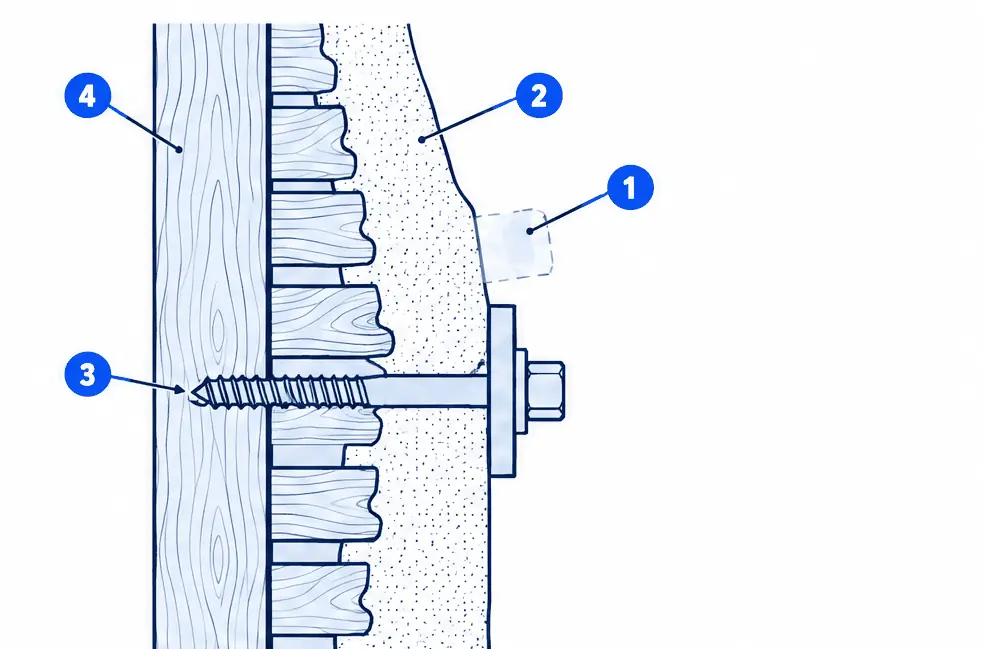
The technique is patient rather than complicated. Masking tape goes over each spot to keep the surface from flaking, the carbide bit runs at low speed with no hammer action, and each lag bolt is long enough to cross the plaster and lath and sink well into the stud. The plaster itself carries no load.
If the studs fall in the wrong places for the screen, a backer board fixed across them lets the TV stay centered where the tape outline put it.
What the numbers show
- Tape over the bolt spot A square of tape holds the finish together at the edge of the hole while the bit turns slowly.
- Plaster over wood lath Plaster squeezed through the gaps between the wood lath strips locks the coat to the wall; the coat holds no screw load, and the lath hides the studs from many finders.
- Long lag bolt Long enough to pass through plate, plaster and lath and still bite deep into the stud.
- Stud The actual support: the bolt finds it with the help of a probe hole.
Arches, niches and thick walls
Spanish Revival rooms often have an arched opening or a recessed niche that looks made for a TV. Many niches are shallow, hollow and framed with little or no wood, so a test hole decides whether one can carry a bracket at all. Built-in bookcases, plate rails and deep casings are part of the house's character; the bracket is placed clear of them, and cords drop to the outlet in a raceway painted to match instead of a channel cut into old plaster. For any change visible from outside, such as an exterior cable or a patio screen on a historic house, the owner checks with the City of Fullerton Planning Division.
Lead paint and older materials
Paint applied before 1978 can contain lead, and some older textured ceilings and joint compounds contain asbestos. Drilling a few bolt holes disturbs very little, especially with a vacuum or dust shroud held at the bit and a cleanup afterward. Opening a wall to hide wiring, or drilling into a textured ceiling, is a larger disturbance, and owners considering it can have the material tested first.
Craftsman and Spanish Revival Home TV Mounting — common questions
Will mounting a TV crack my plaster walls?
Not when it is done slowly. Taped bolt spots, a sharp carbide bit at low speed and bolts long enough to reach the studs keep the plaster intact.
Is it worth hiding the cords inside a plaster wall?
Usually not. A cut in old plaster leaves a repair that almost never matches, so a painted surface raceway down to the existing outlet is the common choice in houses of this age.
Availability & price range
Craftsman and Spanish Revival Home TV Mounting: check availability and price range
Bookings aren't open yet — answer a few quick questions about the TV and the wall and get a typical Fullerton price range right here. Typical Fullerton prices for one TV, labor only unless an option says otherwise. This is a market estimate, not a quote.