
TV Wall Mounting in Fullerton
TV Mounting Line Fullerton handles the most common request in Fullerton, a TV wall mounting job in a living room, bedroom or family room, whether the house is a 1920s bungalow, a 1950s ranch tract or a townhome finished a few years ago. The work comes down to locating solid wood, fixing a flat or tilting bracket to it and leaving the cords neat.
Bookings aren't open yet. Leave your name and number; your message is recorded, and you'll get one message when a local installer is available.
 Illustration
TV Wall Mounting in Fullerton, CA typically runs $100–$415 per TV in our 2027 estimator, depending on the TV size and the wall type. Use the estimator below for your own numbers.
How a standard install runs
Most single-TV jobs on an ordinary wall take one short visit, and doing the steps in order is what keeps the screen secure for years.
- Read the label on the TV. The weight, the VESA hole spacing and the width go on a note. The bracket should be rated for at least 1.5 times that weight.
- Mark the screen in tape. A rectangle of painter's tape the size of the TV is checked from the main seat, which settles the height before anything is drilled.
- Confirm the framing. An electronic finder gives a first guess; a pin-sized test hole inside the tape outline, where the bracket will cover it, confirms solid wood.
- Bolt and level. Pilot holes, lag bolts through the bracket into each stud, then a level across the rails before the final turn.
- Hang the set. The TV hooks onto the rails and the safety screw is set so a bump cannot lift it off.
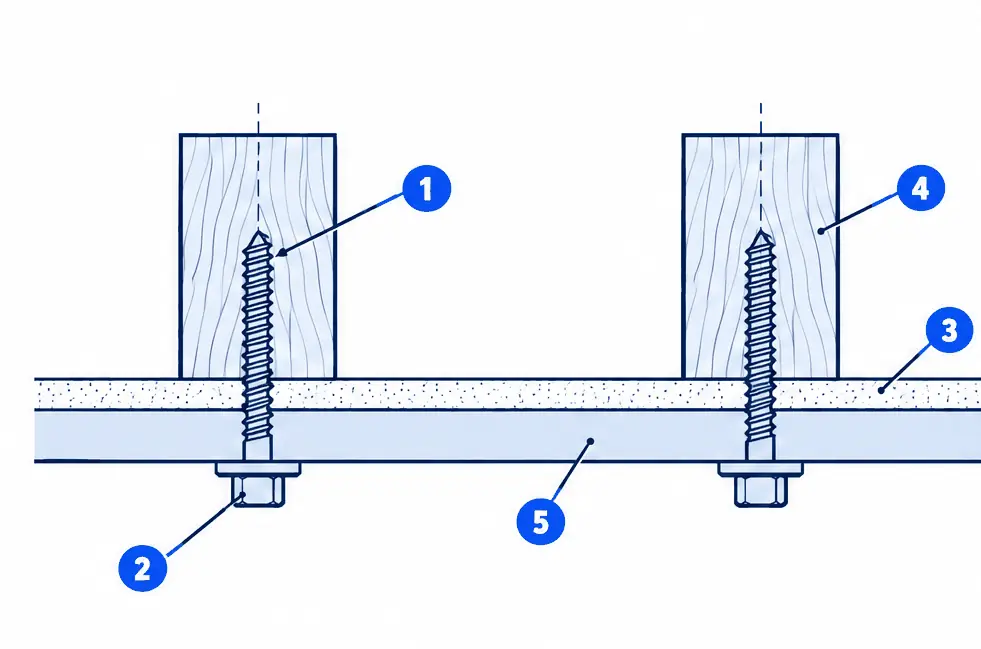
What the numbers show
- Thread in the wood The threaded part ends inside the stud; the stud, not the board, holds the weight.
- Head and washer The washer spreads the clamping force over the plate so the head does not pull through.
- Drywall The board covers the framing and carries almost nothing.
- Stud About sixteen inches center to center in most wood-framed houses, with exceptions around openings.
- Plate A wide plate reaches both studs, so the picture can be centered between them.
Flat or tilted, depending on where people sit
For most rooms the choice is between two simple brackets.
| Bracket | Best when | What you give up |
|---|---|---|
| Flat (fixed) | The middle of the screen can sit close to seated eye level | No angle adjustment once it is up |
| Tilting | The screen has to go higher, or a window faces it | Sits an inch or two off the wall |
Many Fullerton living rooms have a big picture window or a sliding door facing the TV wall, and the west light late in the day lands right on the screen. Tilting the top a few degrees forward is often enough to take that glare away.
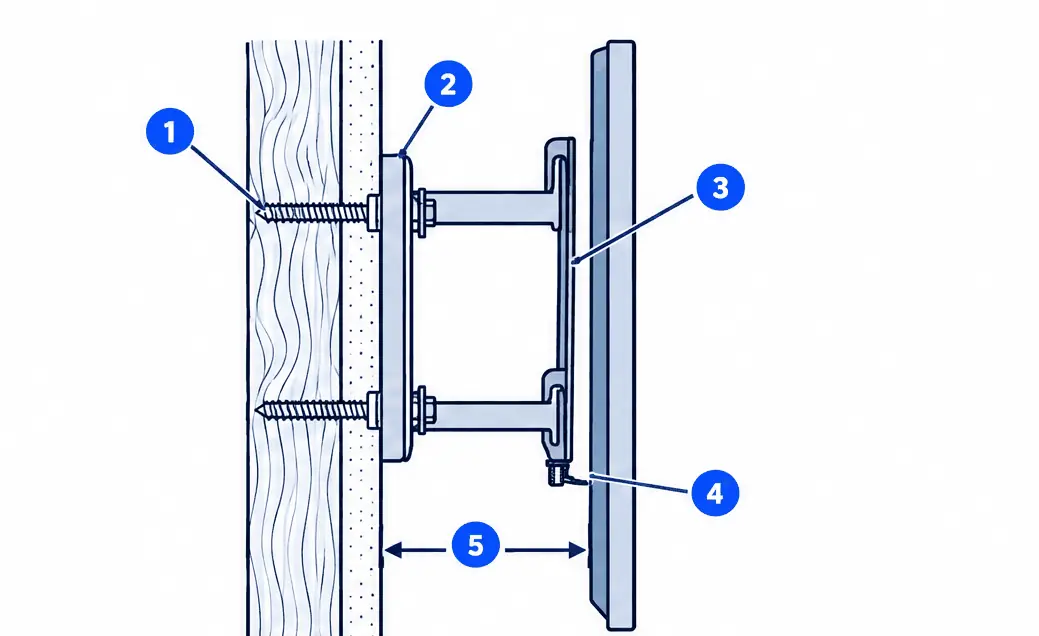
What the numbers show
- Lag bolt in the stud The bolt crosses the plate and the board and finishes deep in the stud, so the wood carries the weight.
- Rail on the plate The TV arms hook over this rail; the plate is set level before the bolts get their final turn.
- Bracket on the TV Screwed to the VESA holes on the set, each arm hangs on the rails; the bracket's rating should be 1.5 times the TV's weight or more.
- Locking screw Set at the bottom of an arm, it keeps a knock from lifting the TV off the rails.
- Gap to the wall Only enough room for the plugs; nothing about a flat bracket adjusts after hanging.
What is behind the wall, house by house
Fullerton's homes were built across a century, and the wall behind the paint changes with the decade.
- 1920s–30s houses in Golden Hill, Brookdale Heights and around Hillcrest Park: plaster on wood lath, with studs that do not always follow a 16-inch rhythm.
- 1950s–60s tracts: mostly drywall on wood studs, sometimes plaster over gypsum lath, which drills harder than it looks.
- Newer townhomes and condos in Amerige Heights and near the campuses: drywall throughout, occasionally on metal studs in interior partitions.
The test hole tells which one a given wall is, and the bolts and bit are chosen from there.
When no stud lands where the TV should be
Centering a screen on a fireplace, a window or a sofa often puts its middle between two studs. A bracket wide enough to reach both usually solves it. Where the gap is too wide, a plywood or steel backer is fastened across three or more studs and the bracket goes onto that.
Hollow-wall toggles rated for the load can hold a small, light screen on drywall, but they are never used in place of wood for a large TV.
Leaving the cords neat
The simplest tidy finish runs the power and HDMI cords straight down behind the screen to an outlet just below it. If the outlet is farther away, a slim raceway painted the wall color covers the run with no cutting. Putting cables inside the wall is a separate add-on with its own rules, since only an in-wall rated power kit may go there, never an ordinary cord, and a new outlet calls for an electrician.
TV Wall Mounting — common questions
What does a simple TV wall mount cost in Fullerton?
In 2027, about $100–$140 for a 32–49 inch TV and $120–$170 for 50–65 inches on drywall over wood studs. Bigger screens, plaster, brick or stone raise it.
Can I use a bracket I already bought?
Usually, as long as its weight rating covers the TV with room to spare and its arms fit the hole pattern on the back of the set. The installer checks both before using it.
How high should the TV go?
For most living rooms, the middle of the screen near seated eye level, roughly 40 to 44 inches off the floor. A tape outline checked from the couch is the quickest way to decide.
Availability & price range
TV Wall Mounting: check availability and price range
Bookings aren't open yet — answer a few quick questions about the TV and the wall and get a typical Fullerton price range right here. Typical Fullerton prices for one TV, labor only unless an option says otherwise. This is a market estimate, not a quote.